
Hotel Revenue Management & AI-Powered Competitor Analysis

Sipping your morning coffee, your eyes catch the hotel next door. Are their lights on? How full is their parking lot? Is there any movement in the lobby? Let’s admit it, we have all tried to estimate a competitor’s occupancy rate by counting license plates in that parking lot or tracking transfer vehicles. Or even worse, in the middle of the day, we assigned a staff member to act as a secret shopper and call the neighboring property: "Do you have availability for this weekend in your Donkey Island view room, and how much is it?" Trying to manage multi-million dollar investments and billion-dollar budgets with these primitive methods, "hearsay" rumors, and morning coffee gossip is like setting sail into the ocean without a compass and then cursing the storm. It is 2026; while the rhythm of the market, the consumption speed of the guest, and the algorithms are this ruthless, the era of managing revenue management based on gut feelings is long gone.
Come on, stop handing the keys to your hotel's profitability over to your competitors, and let’s lay down the codes of modern revenue management on the table.
How Do You Do Your Revenue Management?
For many hotel managers, revenue management consists merely of increasing or decreasing room rates according to the season. However, real revenue management is the art of selling the right room, to the right guest, at the right time, at the right price, and through the most profitable channel.
So, how are you managing this process? With static price lists, or with dynamic pricing (Dynamic Pricing) that flexes according to the real-time breathing of the market? Modern revenue management is built upon these core pillars:
- Demand Forecasting (Forecasting): Analyzing your historical CRM data, regional flight intensity, and seasonal trends to predict occupancy for your next 30, 60, or 90 days.
- Channel Mix Optimization: Balancing profitability across channels like wholesalers, your direct website, and WhatsApp, without making your rooms entirely dependent on OTAs (Online Travel Agencies).
- Visibility Management: Instantly optimizing your conversion rates (Conversion) and your rankings across meta-search platforms.
Are You Still Manually Tracking Competitors' Prices and Occupancies?
If your sales team starts their workday every morning by jumping from tab to tab across Booking, Expedia, and TripAdvisor extranets, manually typing competitor prices into Excel spreadsheets one by one, then past errors loom large. Before you even fill out the third row of that Excel spreadsheet, the competing hotel might have already changed its price three times and snapped up that "hot" guest waiting in line.
Manual tracking does not just waste time; it also creates operational blindness.
- An analysis that would take a human weeks to complete by drowning in spreadsheets is finished by artificial intelligence in seconds.
- A single letter or number typo made during manual data entry can turn your entire pricing strategy upside down, leading to rate parity disruptions (parity rate).
- Most importantly, in manual tracking, you only see the "billboard price." You cannot capture the occupancy pressure behind that price, the competitor's digital reputation score, or instant market movements.
Which Tools Are You Using? (Traditional vs. Artificial Intelligence)
There are traditional RMS (Revenue Management System) tools that have been used in the industry for years. These tools collect historical data for you, draw charts, and dump massive reports in front of you. However, what today's hotelier needs is not more raw data; it is smart solutions that process that data, serve it up like a pill, and turn it directly into actionable insights.
This is exactly where the HotelAI ecosystem steps in, lightening the workload of hoteliers and boosting their profitability. Unlike traditional systems, HotelAI does not just collect data; it manages your hotel's digital reputation, market positioning, and guest communication from end to end.
Thanks to the full synchronization we have completed with the industry's most powerful channel managers, your guest data and availabilities flow instantly into the system. The data grunt work ends, and autonomous management begins.
How Do We Do Competitor Analysis? (The Power of Competitor Analysis V2)
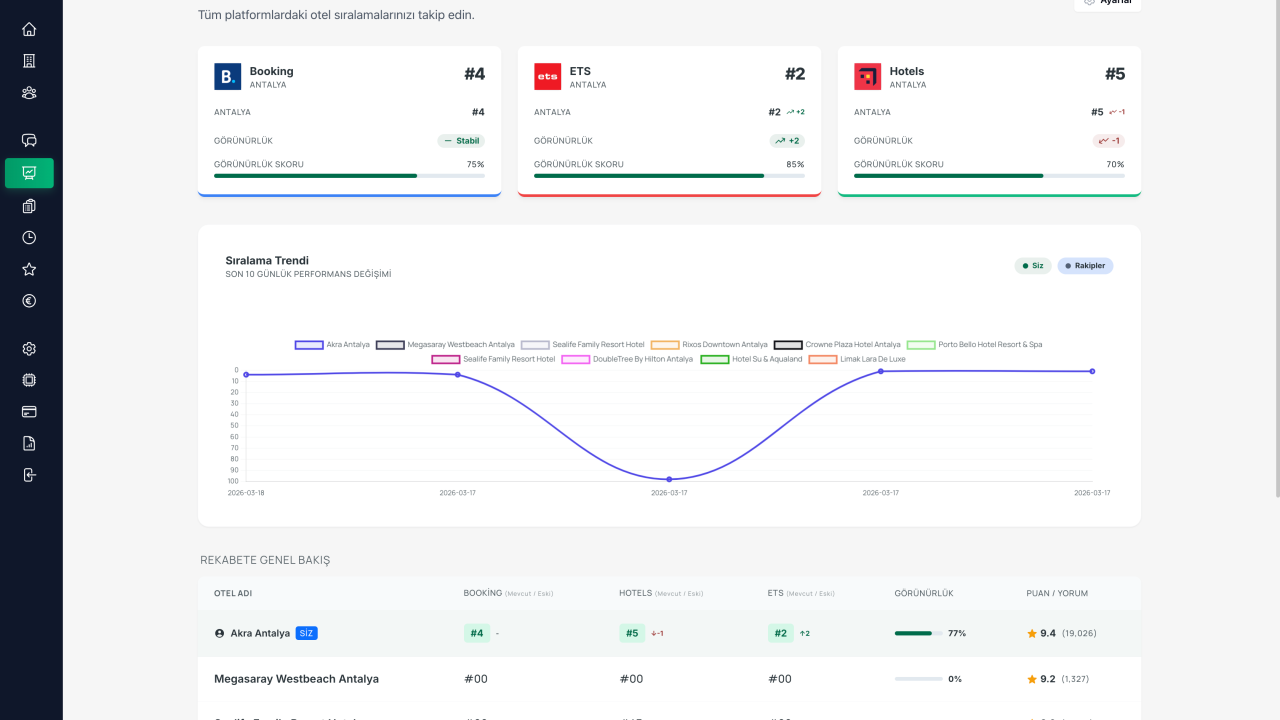
As HotelAI, we have completely transformed that old, shallow concept of "Competitor Analysis" that focused solely on price. With our newly launched Competitor Analysis V2, we analyze not just the numbers, but the identities of the hotels and the psychology of the market.
Because we know that the price competition of a 50-room boutique hotel cannot be the same as a 500-room resort. So, how does our AI perform this analysis in the background?
1. Comparing Apples to Apples (Property Identity)
The system filters the accommodation type (B&B, All-Inclusive), star rating, exact room count, and even which guest segment (family, business travel, couples) your competitor mainly appeals to, listing your "real" competitors for you.
2. Digital Power and Reputation Analysis
How low did your competitor's Booking or Google score drop? What is their OTA tier status? What is their current review count? For example, if your competitor received consecutive bad reviews over the past week and their digital reputation plummeted, they might have panicked and slashed prices because the Lead Time shrank. Our next-generation system tells you: "The competitor's score dropped, do not be fooled by their price cut, your reputation is high; HOLD your price and play for visibility on Meta-Search channels," offering realistic strategies that compare apples to apples.
3. Opportunity Alerts and the Morning Report
You do not need to analyze all these deep insights by sitting in front of a screen for hours every morning. HotelAI sends everything that happened in the last 24 hours (rankings, work orders, competitor prices) straight to your pocket via WhatsApp every single morning as a Morning Report. In that report, you catch this vital sentence: "Opportunity Alert: 3 competitor hotels in your region are completely sold out (Sold Out)!" This specific piece of data triggers the price increase move that will carry your ADR and RevPAR rates to the peak within seconds.
Conclusion: Let the Algorithms Sweat, You Count Your Profits
In the 2026 hospitality world, the era of setting prices by looking at the neighboring hotel's board just to save the day is an operational suicide. Refusing to read the data in your hands is directly turning your back on profitability.
Stop just watching your competitors from afar; truly get to know their strengths, weaknesses, and occupancy pressures through artificial intelligence. The train is leaving the station for you to experience these powerful, competitive tools of HotelAI free for 3 months and transition into the data-driven hospitality era. Make your move before your competitor does!
About the Authors
Sevara ARANCI
Connect on LinkedInCo-Founder, HotelAI
Co-Founder of Hotel AI | AI Assistant Speaking 132 Languages & Reducing Staff Workload by 80% | Tourism Tech Expert. Graduate of Akdeniz University Faculty of Tourism.

Erkan ARANCI
Connect on LinkedInCo-Founder & CTO, HotelAI
Co-Founder & CTO of Hotel AI | Architect of Web, Mobile & Desktop Integration Systems | Full Stack Developer.